More than 766,000 Americans died with COVID-19 recorded as the underlying cause of death during 2020 and 2021.
Schools closed. Businesses were ordered shut. Children sat in front of computer screens instead of teachers. Parents lost jobs. Families were separated from dying relatives. Weddings, funerals, church services and ordinary human interaction were restricted in the name of public health.
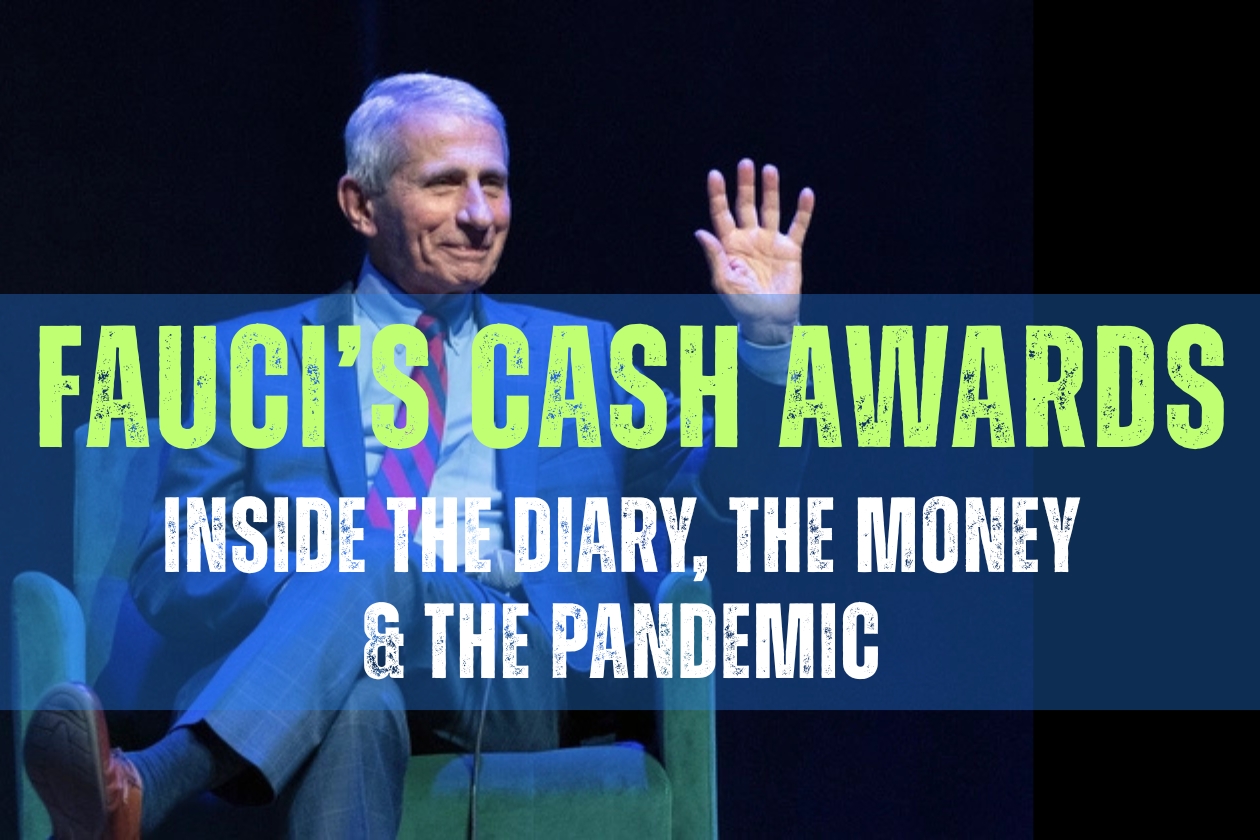
Meanwhile, Dr. Anthony Fauci—the most recognizable face of America’s pandemic response—personally received at least $912,460 in documented cash-award proceeds.
That equals approximately $1.19 in cash awards for every American whose death certificate listed COVID-19 as the underlying cause during 2020 and 2021.
That comparison is symbolic. Fauci was not literally paid according to the number of deaths, and the awards did not cause those deaths. But the contrast is one the American people have every right to examine.
The deeper story is not simply that a famous scientist won an award. Records released by Sen. Rand Paul show Fauci discussing possible prizes, supplying or offering to supply nomination materials, and receiving substantial assistance from colleagues and personnel inside his federal office. One of those prizes ultimately deposited nearly $900,000 into Fauci’s personal bank account.
The $899,960 deposit
The largest known payment came from the 2021 Dan David Prize, an international award nominally valued at $1 million. Ten percent of the prize was designated for scholarships.
In a March 23, 2022 email correcting his annual financial disclosure, Fauci wrote:
“The Dan David prize that was deposited in my bank account was $899,960.00.”
Fauci also reported receiving $12,500 personally from the Elliot Richardson Prize after the other half of its $25,000 value was directed to charity.
Together, those two documented personal payments total $912,460.
Federal ethics officials prevented Fauci from personally accepting cash attached to certain other awards when the sponsoring institutions had funding relationships with the National Institute of Allergy and Infectious Diseases. The Dan David payment, however, was formally cleared and deposited into his account.
Fauci did not simply wait for awards to find him
Fauci’s defenders can fairly argue that he spent decades working in infectious-disease research and was a natural candidate for major scientific recognition. His career was long and influential.
But the correspondence challenges the image of a completely passive award recipient.
In communications with longtime scientific associate Dr. Barton Haynes, Fauci discussed awards for which he could potentially be nominated. In one exchange, after discussing a Shaw Prize nomination, Fauci raised another opportunity:
“There is another one that looks possible for me. It is the Dan David Prize.”
He indicated that he would supply the necessary material.
An unsolicited honor is one thing. Identifying a lucrative prize, working through an eligible nominator and helping provide the case for why you should receive it is something else.
That does not prove fraud, bribery or an illegal arrangement. It does show that Fauci was actively involved in pursuing recognition that could produce substantial personal financial benefit.
The colleagues and government personnel who helped
Dr. Barton Haynes
Haynes, a prominent Duke University scientist and longtime Fauci associate, participated in discussions involving several possible nominations, including the Shaw Prize, Heinz Award and Dan David Prize. The correspondence shows Fauci asking about nomination requirements and offering to provide supporting materials.
Haynes and institutions associated with his research had significant NIAID funding relationships. That connection creates a legitimate conflict-of-interest question. It does not, standing alone, prove that federal grants were exchanged for nomination assistance. Establishing a quid pro quo would require evidence connecting a specific funding decision to the nomination.
Dr. Charles Dinarello
Dinarello formally submitted the successful Dan David nomination. In correspondence included in the Senate release, he thanked Fauci and NIAID Chief of Staff Greg Folkers for doing “most of the work” involved in the submission.
The formal nominator may have filed the application, but the nominee and people working inside his federal office appear to have helped build it.
Greg Folkers and other NIAID personnel
Folkers served as Fauci’s NIAID chief of staff. A November 2020 email shows him working on the Dan David nomination and seeking language from other NIAID employees to strengthen—or “beef up”—the COVID portion of the submission.
Other federal employees helped with nomination language, descriptions of NIAID’s pandemic response, biographical materials, ethics processing, communications with award organizers, publicity and payment administration.
The timing matters. The work was occurring during the pandemic, while deaths were rising, businesses were struggling and millions of children remained outside normal classrooms.
Government ethics officials concluded that Fauci could accept the Dan David payment as a legitimate award from an independent private foundation. That resolves the narrow legal question of whether existing gift rules permitted acceptance.
Should taxpayer-funded employees be used to help pursue, process and publicize a private award worth nearly $900,000 to their boss?
Fauci’s federal compensation
Fauci was not the director of the entire National Institutes of Health. He served as director of the National Institute of Allergy and Infectious Diseases, one institute within NIH, from 1984 until December 2022. He also served as President Joe Biden’s chief medical adviser from 2021 through 2022.
| Year | Reported salary |
|---|---|
| 2020 | $434,312 |
| 2021 | $456,028 |
| 2022 | $480,654 |
| Total | $1,370,994 |
Combining those reported salaries with the two documented personal award payments produces approximately $2,283,454.
That is a gross comparison, not net income after taxes. It does not include the value of health insurance, paid leave, federal retirement benefits, investment income, his wife’s earnings or income earned after retirement.
Outside watchdog OpenTheBooks estimated that Fauci’s federal pension could approach or exceed $400,000 annually. That remains an outside estimate, not an official individual pension statement released by the Office of Personnel Management.
What Americans endured
766,230 underlying-cause COVID deaths in 2020 and 2021
Final CDC data list COVID-19 as the underlying cause in 350,831 deaths in 2020 and 415,399 deaths in 2021, for a combined total of 766,230.
Dividing $912,460 by 766,230 produces approximately $1.19. Again, this is a symbolic comparison—not an allegation that Fauci was compensated for deaths.
55.1 million students affected by school closures
At the peak of the spring 2020 shutdown, at least 124,000 public and private schools were closed, affecting approximately 55.1 million students.
Most students remained formally enrolled and were offered some form of remote instruction. But millions lost normal access to teachers, classmates, counselors, therapists and special-education services. Some returned within months; others spent much of the following school year fully remote or on hybrid schedules.
The Nation’s Report Card later found that average scores among nine-year-olds fell five points in reading and seven points in mathematics between 2020 and 2022. It was the largest reading decline since 1990 and the first mathematics decline recorded in that long-term assessment.
1.6 million business establishments experienced mandated closures
The Bureau of Labor Statistics reported that approximately 1.6 million U.S. business establishments—19 percent of establishments surveyed—experienced a government-mandated closure during 2020. Those locations employed roughly 26 million workers.
“Establishment” means an operating location, and the figure does not mean all 1.6 million closed permanently. But it captures the scale of government-ordered disruption.
Was Fauci responsible for the shutdowns?
Fauci did not possess legal authority to close every American school or business. Governors, mayors, health departments and school boards issued the actual orders. Presidents, executive agencies, military leaders and employers were responsible for their own mandates.
It would also be misleading to portray Fauci as a powerless observer. He was the nation’s most influential infectious-disease adviser and publicly supported aggressive restrictions. In April 2020, he argued that every state should adopt stay-at-home measures. He later became a prominent advocate of broad masking and physical distancing.
His positions evolved over time, and he later supported reopening schools in many circumstances and argued against repeatedly shutting down the entire country.
The fairest conclusion is that Fauci did not sign every closure order, but his authority, platform and recommendations helped legitimize policies that state, local and federal leaders imposed.
The six-foot rule that “sort of just appeared”
During congressional questioning in January 2024, Fauci was asked about the scientific basis for requiring six feet of physical separation. He said the threshold had “sort of just appeared” and could not identify a specific body of evidence that established exactly six feet.
That does not mean physical distance was meaningless. Greater distance can reduce exposure, and risk also depends on ventilation, filtration, duration, crowding and whether people are indoors.
What was not firmly established was the treatment of exactly six feet as a clear line between safety and danger. Yet the rule shaped classroom capacity, restaurant seating, workplace operations and public behavior across the country.
What the diaries show about a possible laboratory origin
The released records do not prove that Fauci knew with certainty that SARS-CoV-2 escaped from a laboratory.
They do support a narrower but consequential conclusion: Fauci knew very early that respected scientists considered a laboratory-associated origin a genuine possibility.
Bat-virus ancestry and a laboratory accident are not mutually exclusive. A bat-related coronavirus could conceivably reach humans through natural spillover, wildlife collection, laboratory research, accidental exposure or another route.
The accountability question is whether the uncertainty discussed privately was communicated honestly to the public—or whether a laboratory-associated origin was dismissed publicly with greater confidence than the private evidence justified.
From bipartisan trust to national division
Fauci began the pandemic with extraordinary public support. An April 2020 Quinnipiac poll found 78 percent approved of his handling of the crisis and only 7 percent disapproved.
By December 2021, Gallup measured his approval at approximately 52 percent, with the country nearly evenly divided. More recent trust and confidence surveys have generally placed him near half the country rather than the overwhelming support he enjoyed in early 2020.
The diary material shows extensive attention to interviews, television appearances, praise, celebrity encounters, awards and Fauci’s rapidly expanding public profile. That can reasonably leave readers with the impression of an official intensely conscious of his reputation and legacy.
What the evidence proves—and what it does not
The records support reporting that Fauci actively discussed and pursued certain awards; offered to provide nomination materials; received assistance from scientific colleagues and NIAID personnel; received $899,960 from the Dan David Prize and $12,500 from the Elliot Richardson Prize; advocated major pandemic restrictions; and knew that a laboratory-associated origin was being seriously discussed early in the pandemic.
The records do not presently prove that Fauci was bribed, traded grants for nominations, illegally accepted the Dan David payment, personally ordered every school or business closed, knew conclusively that COVID escaped from a laboratory, or caused any COVID death through his pursuit of awards.
A Personal Note From Steven Tauriello
Perhaps the most disturbing question of the entire COVID era is this:
How did one unelected government official accumulate so much influence over the daily lives of the American people?
Dr. Anthony Fauci did not personally sign every school-closure order, close every business or issue every vaccine mandate. Governors, presidents, military leaders, health departments, employers and school boards exercised their own authority.
But Fauci became the face and voice of the system that justified it all.
His recommendations carried enormous weight. His words influenced whether children entered classrooms, whether businesses opened their doors, whether Americans covered their faces, whether families gathered together and whether workers believed they would be allowed to keep their jobs without accepting a medical treatment.
We watched schools close.
We watched businesses collapse.
We watched children lose irreplaceable time in classrooms.
We watched Americans ordered to remain inside their homes, stand six feet apart and cover their faces.
We watched members of the military discharged after refusing COVID vaccinations.
We watched workers across the country face one of the most coercive ultimatums a government can impose:
Accept the shot—or risk losing the job that feeds your family.
No American should ever be placed in that position again.
The government should never be permitted to force a medical procedure upon a citizen through threats against that person’s employment, education, military career or ability to participate in ordinary society.
It should never again be able to close a person’s business, remove children from classrooms, confine healthy citizens to their homes or transform emergency guidance into open-ended control without overwhelming evidence, strict legal limits and meaningful public accountability.
The American people should never forget what happened in 2020.
This did not happen to some distant, anonymous population.
It happened to us.
It happened to me and to you.
It happened to our mothers and fathers, our sons and daughters, our husbands and wives, our brothers and sisters, our grandparents, aunts, uncles, cousins, friends, neighbors and coworkers.
We were told where we could go, whom we could visit, whether we could work, whether our businesses were considered essential and what medical decisions we were expected to make.
Families were separated from loved ones in hospitals and nursing homes. People died without relatives beside them. Funerals were restricted. Churches were closed. Children were isolated. Parents were terrified of losing their incomes.
The American people were not merely inconvenienced.
We were subjected to an extraordinary expansion of government authority over the most personal areas of human life.
And there has been no true national reckoning.
There has been no comprehensive accounting of who made each decision, what evidence supported it, what evidence was ignored, which restrictions caused more harm than benefit and why officials who got major decisions wrong continued receiving promotions, awards, book deals, television appearances and public praise.
There are more Dr. Faucis in the federal government.
There will always be officials who believe their expertise gives them the right to make decisions for millions of citizens. There will always be institutions willing to expand their authority during an emergency. There will always be politicians who find it easier to defer to unelected experts than to accept responsibility themselves.
That is precisely why accountability matters.
Without a reckoning, it will happen again.
The next emergency may involve another virus, a cyberattack, terrorism, climate, financial instability or a threat we cannot yet imagine. The justification will change, but the temptation will remain the same:
Give the government extraordinary power now, and ask questions later.
Americans must reject that bargain.
Emergency authority must be limited, transparent, temporary and subject to legislative and judicial oversight. Scientific advice must remain advice—not unquestionable law. Public-health officials must disclose uncertainty rather than disguise assumptions as settled science. Policies must be continually reevaluated as evidence changes.
Most importantly, Americans must retain the right to make decisions about their own bodies, families, children, businesses and livelihoods.
COVID became a battle over ideas, rights and the proper limits of government power.
Some Americans complied because they were afraid.
Some complied because they trusted the government.
Some complied because they believed it was necessary to protect others.
Others resisted because they believed the government had crossed a constitutional and moral line.
They refused the vaccine.
They refused masks.
They reopened their businesses.
They demanded that their children return to school.
Whether a person agreed with each act of resistance or not, the right to question government authority is fundamental to the American system.
The answer to government overreach is not violence. It is determined, lawful resistance through elections, courts, investigations, legislation, journalism, public-record requests, congressional oversight and the refusal to surrender constitutional rights merely because officials declare an emergency.
COVID eventually faded, but we cannot honestly say the American people decisively won the argument over government power.
In many ways, the emergency simply ended before the country fully confronted what had been done.
That is not enough.
The framers of this country distrusted concentrated power because they understood human nature. They knew that authority granted during a crisis is rarely surrendered willingly. They designed a system in which government answers to the people—not one in which citizens must ask permission from government officials to work, worship, assemble, educate their children or make medical decisions.
The lesson of COVID must never be forgotten:
No person, agency or administration should ever again be allowed to accumulate that degree of unchecked influence over the American people.
There must be investigations.
There must be transparency.
There must be reforms.
There must be consequences where laws or ethical rules were violated.
And there must be safeguards strong enough to prevent the same abuses from being repeated under a different official, a different administration or a different emergency.
Americans should remember COVID—not to remain trapped in anger, but to ensure that fear is never again used to strip away rights without accountability.
We must make certain that the next generation does not face the same ultimatum:
Obey—or lose your job.
Comply—or lose your education.
Submit—or lose your place in society.
Not again.
Not in this country.
Sources reviewed
- Office of Sen. Rand Paul: Reading Room and Fauci document releases
- Senate release: Fauci Awards records
- CDC: Mortality data
- Bureau of Labor Statistics: 2020 Business Response Survey
- Education Week: Nationwide school-closure tracking
- The Nation’s Report Card: 2022 long-term trend results
- House Oversight Committee: Fauci transcript summary
- Quinnipiac University Poll: April 2020 Fauci approval
- Gallup: December 2021 federal leadership approval
Editor’s note: This article combines documented reporting and clearly labeled commentary. The $1.19 figure is a mathematical comparison and is not an allegation that Fauci was paid for individual deaths.