What was reported
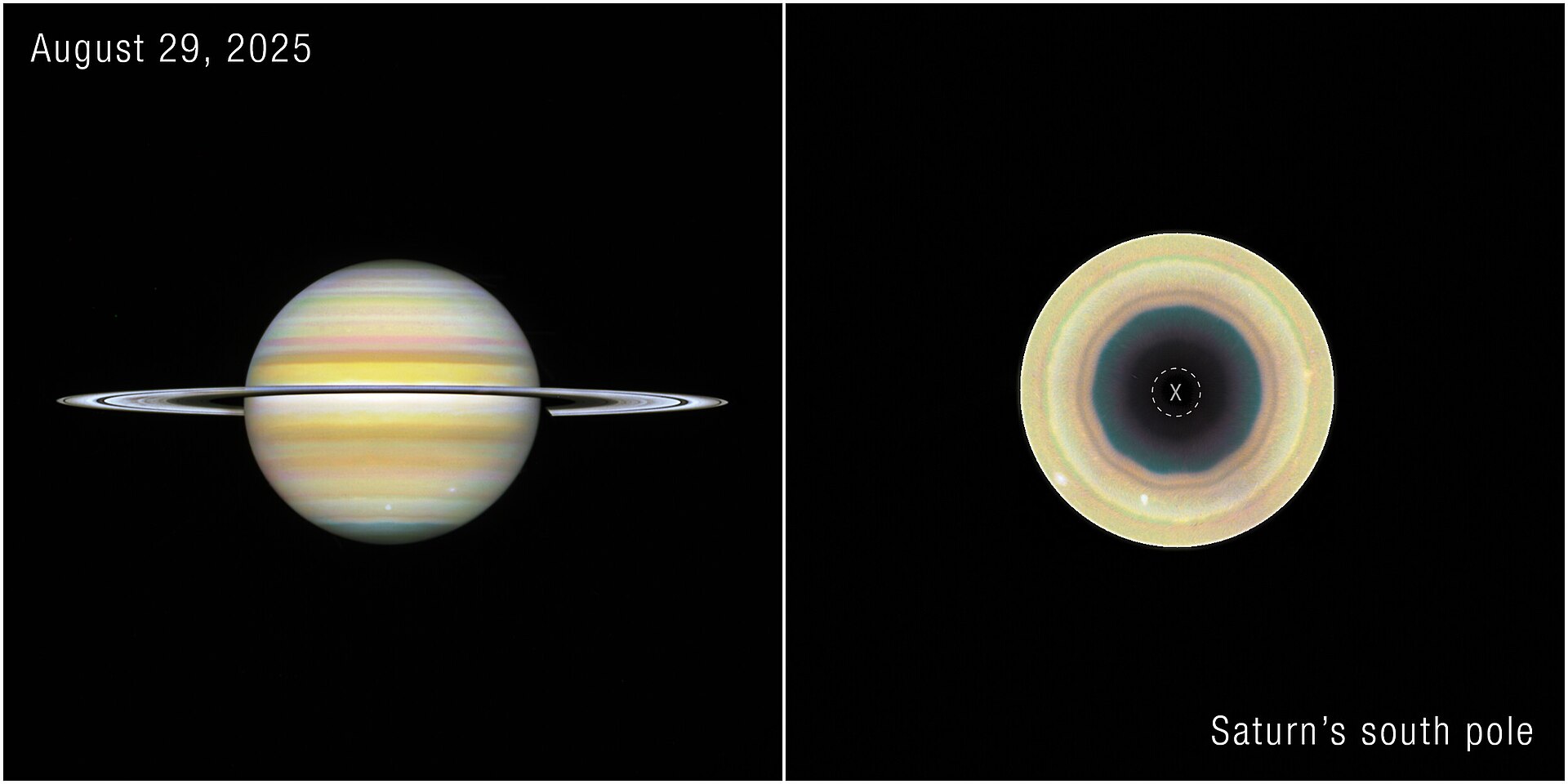
Multiple news outlets reported images attributed to NASA's Hubble Space Telescope that show a large, polygonal atmospheric wave encircling Saturn's south pole. FOX Weather described the discovery as a "giant atmospheric wave" revealed by Hubble. Audacy characterizes the structure as a massive 10-sided wave, while Curiosmos refers to the feature as a decagon around the polar vortex.
The accounts across these outlets emphasize the visual clarity and geometric regularity of the feature — a bright, multi-edged wave pattern wrapping the polar region. None of the three summaries supplied to Freedom News includes a direct NASA press release, an arXiv preprint, or a peer-reviewed paper that presents the images and measurements, so the reporting relies on the Hubble attribution as described by the outlets themselves.
What the reporting does — and does not — specify
The available summaries consistently identify the source imagery as Hubble observations and describe the polygonal shape as ten-sided. Beyond that, the supplied coverage does not include technical details such as measured wavelength or amplitude of the wave, the imaging dates, the Hubble instruments or filters used, or credits to specific investigators or institutions.
Because the primary NASA statement or a scientific paper is not included in the source set reviewed for this article, key observational metadata and quantitative measurements remain unconfirmed here. Freedom News notes these gaps explicitly: there is not yet a primary Hubble press release or peer-reviewed record in the sources provided that would let reporters verify instrument settings, processing steps, or the numerical properties of the wave.
Why planetary scientists pay attention to polygonal polar structures
Polygonal, multi-edged features near planetary poles are scientifically interesting because they reveal how large-scale atmospheric flows organize under the influence of rotation, thermal contrasts, and internal dynamics. In broad terms, persistent geometric features indicate stable interactions between jet streams, vortices, and waves in the atmosphere; they can also mark regions where winds shear or where different temperature or compositional layers meet.
Observations of such structures give researchers testable constraints for atmospheric models. Measuring the number of edges, the radial extent, and how the pattern evolves over time helps scientists infer the balance of forces — for example, whether wave modes are being excited by instabilities in the jets, by differential heating, or by interactions with deeper atmospheric layers. On gas giants, these diagnostics are one of the few practical ways to probe dynamics below the visible cloud tops.
How this fits into broader Saturn research — cautiously
The immediate reporting frames the Hubble images as a visually striking new observation of Saturn's south polar dynamics. Without the underlying technical record in hand, Freedom News does not attempt to draw firm conclusions about the origin or longevity of the ten-sided wave. However, the discovery reported by multiple outlets will likely be placed by researchers in the context of earlier polar and global studies of Saturn when primary data are released.
Planetary scientists typically compare new remote observations to legacy datasets — for Saturn that can include ground-based telescopes, space missions, and long-term monitoring programs — to determine whether a feature is transient or persistent. The next steps for the community will be independent confirmation, analysis of the imaging geometry and spectral filters used, and publication of quantitative measurements that modelers can test against atmospheric dynamics theories.
What to watch next
Freedom News will look for a primary NASA or Hubble Space Telescope press release, the image credits and technical notes that usually accompany archival Hubble imagery, and a preprint or peer-reviewed paper that provides measurements and an interpretation. Those records should disclose imaging dates, the Hubble instrument and filters, data processing steps, and the names and affiliations of the investigators.
Follow-up observations — either from Hubble, other space telescopes, or ground-based facilities — and a formal scientific paper will be needed to confirm whether the decagon is a transient wave, a long-lived mode, or an artifact of viewing geometry or image processing. Until those records appear, the available news reports offer an intriguing visual discovery but not the full scientific dossier researchers rely on to reach firm conclusions.