What was reported
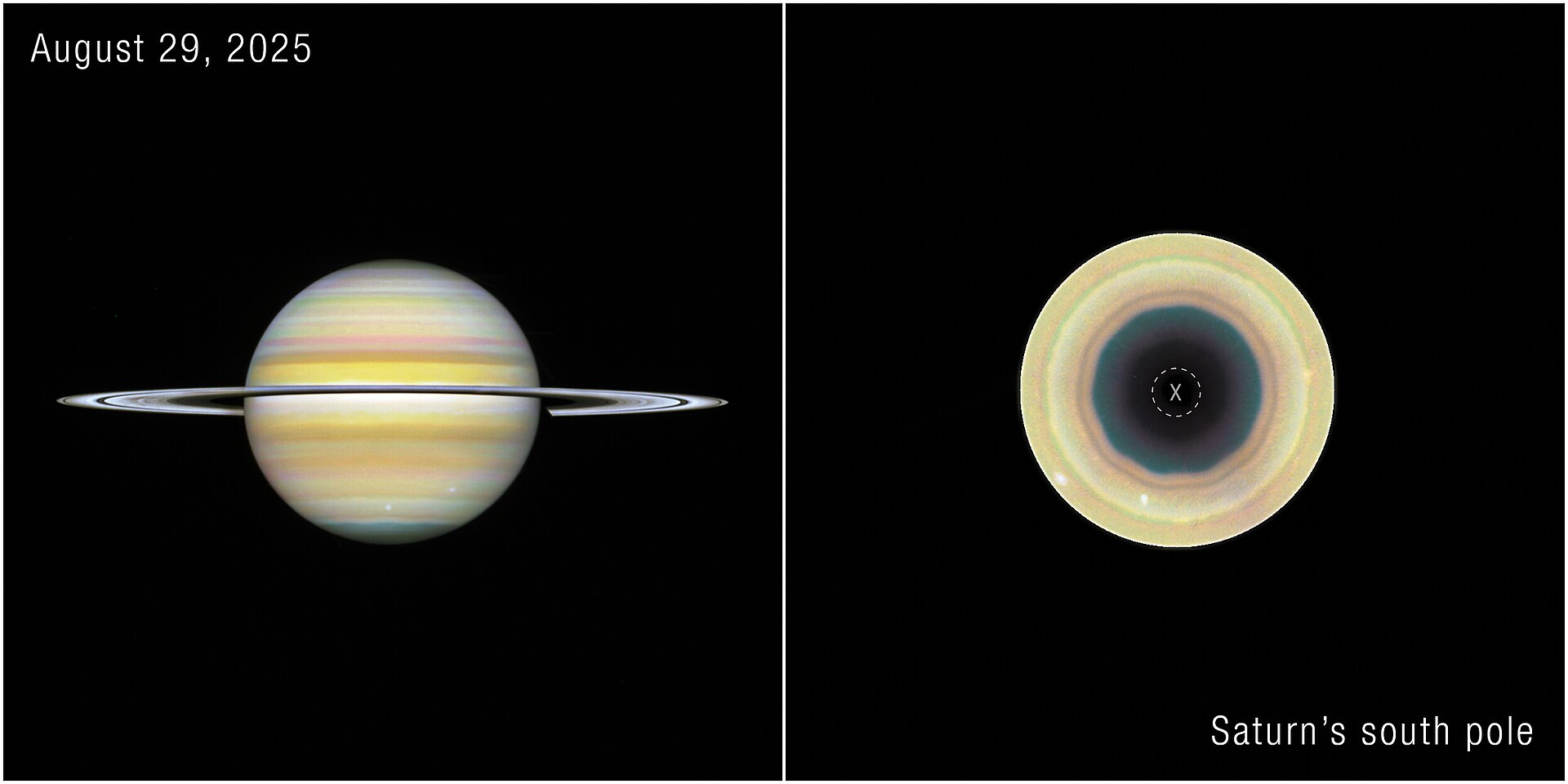
Between Sept. 2 and Sept. 3, 2026, multiple outlets reported that the Hubble Space Telescope has imaged an unusual ten-sided geometric pattern in Saturn's clouds near the planet's south pole. Coverage reviewed by Freedom News Staff includes reports in BBC Sky at Night Magazine, ScienceDaily, Space, WMAZ and The News International, each describing the feature as a decagon-shaped structure visible in Hubble data.
Outlets describe the structure in consistent terms — a roughly ten-sided, polygonal arrangement appearing in cloud formations at Saturn's southern polar region. The reporting treats the pattern as an unexpected and visually striking atmospheric feature; several headlines use the shorthand 'decagon' or '10-sided' to convey its geometric character.
The stories are recent and contemporaneous: the Space report appeared on Sept. 2, 2026, while BBC, ScienceDaily, WMAZ and The News International published on Sept. 3, 2026. None of the supplied summaries included the text of a peer-reviewed paper, a direct Hubble press release URL, or the names of a lead author responsible for the discovery.
What we can and cannot verify from available reporting
The core claim — that Hubble imagery shows a ten-sided pattern in Saturn's southern-polar clouds — is corroborated across at least five independent news outlets in the supplied summaries. That cross-outlet agreement provides a reasonable basis to report the observation itself while noting that the primary Hubble release or journal paper was not included in the material supplied for this story.
Critical details are not present in the supplied summaries. The specific Hubble instrument or filter used to capture the images, the observation dates recorded by Hubble, the team or principal investigator credited with the interpretation, and any underlying data release are not contained in the summaries we reviewed. Because those primary records were not part of the source set, Freedom News Staff does not claim to have independently examined the original Hubble images or data files.
None of the supplied summaries in this set included direct comments attributed to named researchers or an unaffiliated planetary scientist. That means the story as presented here accurately reflects the secondary reporting available but cannot substitute for confirmation from the Hubble team, NASA press office, or a peer-reviewed publication. We will update the article when the primary Hubble release, the observing instrument and dates, or researcher statements become available.
Why this matters, what scientists will want to know next
Geometric and polygonal features in the atmospheres of gas giants are rare enough that a newly reported ten-sided pattern attracts immediate scientific interest. If the pattern is confirmed and persists, it could offer new constraints on atmospheric dynamics near Saturn's poles — including the interplay of winds, waves, jet streams and possibly resonant oscillations — but the supplied summaries do not provide the team's interpretation or proposed mechanisms.
Key follow-up questions that will determine scientific value include whether the decagon is a transient weather pattern or a long-lived structural feature, whether it is visible at multiple wavelengths and altitudes, and whether dynamical models can reproduce a ten-fold symmetry under plausible conditions. Answering those questions normally requires access to the raw or processed Hubble images, time-series observations to measure persistence and motion, and independent modeling by atmospheric physicists.
For readers watching this story develop: expect confirmation steps over the coming days and weeks. The most decisive primary records will be (a) an official Hubble/NASA/ESA image release or press notice describing the observation and the instrument/dates used, (b) a preprint or peer-reviewed paper laying out the data analysis and the authors' proposed physical explanation, and (c) independent commentary from planetary scientists who were not part of the reporting team. At present, the available news coverage establishes the observation as widely reported but not yet exhaustively documented in the primary scientific record.
How Freedom News approached this report
This article summarizes the consistent reporting across multiple independent outlets that Hubble has imaged a ten-sided structure at Saturn's south pole. In line with Freedom News editorial standards for scientific coverage, we did not invent or attribute technical specifics that were missing from the supplied summaries. We will seek and add primary-source material — the Hubble image release, instrument and observation metadata, and statements from the research team or independent experts — before publishing subsequent updates that attempt to explain the feature's physical cause.
Readers interested in the underlying data should look for an official NASA/ESA Hubble image release or a preprint on public servers such as arXiv; when those primary records appear, they will allow stronger verification of the observing instrument, exact dates, and the researchers' proposed mechanisms. Until then, the best-supported fact is the cross-outlet report that Hubble imagery shows a decagon-like pattern near Saturn's south pole; the reasons for that pattern remain an open scientific question.
Sources reviewed
- BBC Sky at Night Magazine: Something weird's going on at Saturn. Hubble has spotted a 10-sided geometric formation in the planet's clouds
- sciencedaily.com: NASA scientists discover a giant 10-sided pattern on Saturn
- Space: Astronomers discover mysterious 10-sided cloud structure at Saturn's south pole
- WMAZ: Mysterious decagon-shaped structure confirmed on Saturn
- The News International: NASA Hubble spots strange 10-sided ‘decagon’ swirling around Saturn’s south pole