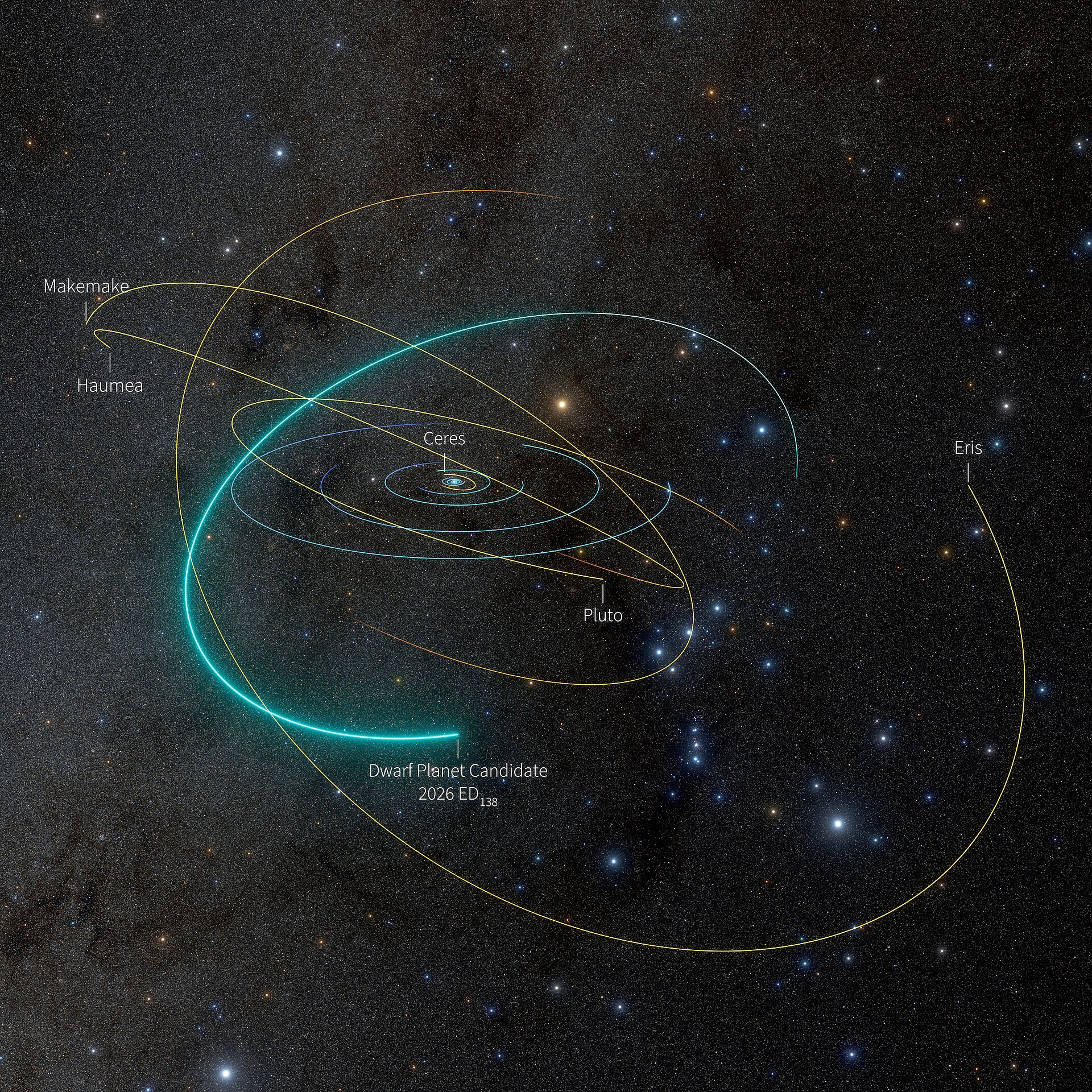
What the coverage says right now
National Geographic led the mainstream coverage with a story headlined that astronomers discovered a new hidden world beyond Neptune. That account is matched by a cluster of science and local outlets that picked up the development and emphasized slightly different angles: some outlets focused on the object's potential status as a dwarf planet, others on the surprise of the find, and at least one named the survey telescope associated with the discovery.
Scientific American's summary explicitly identifies the Vera C. Rubin Observatory as the likely source of the detection and frames the object as a potential sixth dwarf planet in the solar system. Florida Today, Space, ZME Science, The Debrief, The Daily Galaxy, inkl, India Today and other outlets carry similar headlines noting a mysterious object beyond Pluto or Neptune that could be a new dwarf planet or a significant trans‑Neptunian object (TNO).
What we do not yet have from the sourced coverage
None of the supplied summaries includes the underlying primary records astronomers normally publish after a new minor‑planet detection: there is no Minor Planet Center (MPC) electronic circular or observation report, no preprint or peer‑reviewed paper linked in the summaries, and no set of orbital elements (such as semimajor axis, eccentricity, inclination, perihelion/aphelion distances, current heliocentric distance, or provisional designation).
Because orbital elements and the formal MPC posting are absent from the available coverage, key classification details remain unverified here. In particular, the supplied stories do not provide the object's provisional designation, an observational arc length, its absolute magnitude (H), estimated diameter, or the specific evidence required to label it an ‘‘extreme trans‑Neptunian object’’ versus a more typical detached or scattered TNO. Those numbers are the basis astronomers use to decide whether an object plausibly qualifies as a dwarf planet or simply a large TNO.
What the reporting suggests — and what that would mean
Several outlets use the phrase dwarf‑planet candidate; that is consistent with early reporting language scientists use when an object appears large enough to be round under its own gravity but formal classification awaits follow‑up. If the object were confirmed as a new dwarf planet beyond Neptune, outlets describing it as a possible sixth dwarf planet are implying it would join Pluto, Eris, Haumea, Makemake and Ceres in that classification—though any formal designation would depend on additional observations and review by the International Astronomical Union and the Minor Planet Center processes.
Because Scientific American and others link the discovery to the Vera C. Rubin Observatory, the find would be consistent with expectations: Rubin’s wide, deep, high‑cadence survey is designed to reveal previously hidden distant solar‑system bodies. A Rubin detection would typically be followed by rapid community follow‑up to extend the observational arc and refine the orbit, then an MPC posting of the provisional designation and orbital elements, and eventually a scientific writeup or preprint.
Why the primary records matter and where to look next
For any new solar‑system object the authoritative early records are (a) the Minor Planet Center's electronic circular or new‑object listing, which posts provisional designations and observation submissions, and (b) the orbital elements published either in an MPC notice or in a peer‑reviewed paper or preprint. Those documents provide the semimajor axis, eccentricity, inclination and observation arc needed to judge whether an object is an extreme TNO, a detached object, or on a more ordinary scattered‑disk orbit.
If you want to follow this discovery beyond the headlines, check the Minor Planet Center's recent new‑object posts and the JPL Small‑Body Database for any newly assigned provisional designation. Also look for an observatory press release from the Vera C. Rubin Observatory or for an arXiv preprint from the discovery team. Until one of those appears and provides the orbit and magnitude measurements, classification terms like ‘‘dwarf planet’’ or ‘‘extreme TNO’’ remain provisional descriptions reported by news outlets rather than fully verified scientific records.
Context and what to watch next
Discoveries of distant solar‑system objects often proceed from an initial detection to community validation over days or weeks. Early announcements in popular outlets can be accurate in headline terms but typically precede the more technical MPC posting that astronomers use to coordinate follow‑up. Following that process is how the community establishes whether an object deserves the ‘‘dwarf planet’’ label or will remain an interesting but smaller trans‑Neptunian body.
Freedom News will monitor the Minor Planet Center, the Vera C. Rubin Observatory news feed, arXiv for preprints from the reported discovery team, and the JPL Small‑Body Database. When the MPC listing and orbital elements are available, readers should expect a technical update including the provisional designation, orbital parameters, estimated size, and what those numbers imply about dynamical class and long‑term orbit stability.
Sources reviewed
- National Geographic: Astronomers Just Discovered a New Hidden World Beyond Neptune
- Florida Today: World spotted beyond Pluto could be solar system's next dwarf planet
- Scientific American: The Vera C. Rubin Observatory may have just discovered our solar system’s sixth dwarf planet
- Space: Astronomers found a mysterious object beyond Neptune, and it could be a new dwarf planet
- inkl: Astronomers Find Mysterious Object Beyond Neptune and Experience 'Excited Disbelief' Over Discovery
- India Today: Did astronomers just find a new planet in our Solar System? Yes and no
- ZME Science: Astronomers Have Found a Possible New Dwarf Planet Beyond Pluto. It's the Sixth in the Solar System and It Was Hiding in Plain Sight
- The Debrief: A Massive New Object Has Been Discovered Beyond Pluto—Could It Be a Dwarf Planet?
- The Daily Galaxy: A Hidden World Beyond Pluto Has Just Been Found, and It Could Rewrite the Solar System's Map