BUTLER, Pa. — More than two years after Thomas Matthew Crooks opened fire at a Donald Trump campaign rally in Butler, Pennsylvania, a newly disclosed detail has added another unanswered question to a case that has generated significant public skepticism.
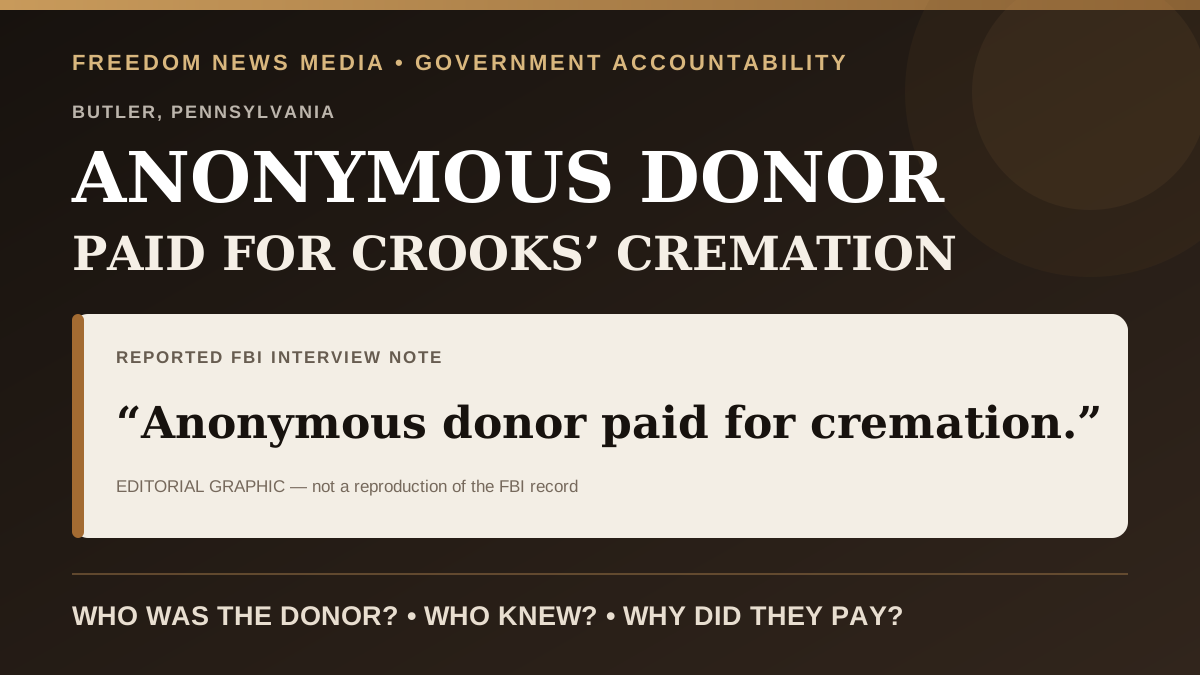
Fox News and the New York Post report that federal records provided to Senate Judiciary Committee Chairman Chuck Grassley include a note stating: “Anonymous donor paid for cremation.” Fox News reports that a lawyer representing the Crooks family told investigators that Crooks had been cremated shortly after the shooting and that the cremation was paid for by an anonymous donor.
The donor has not been publicly identified. The records described in the reporting do not explain why the person paid, whether the donor knew Crooks or his family, or whether investigators established the donor’s identity.
That does not establish that the donor had anything to do with the assassination attempt. No public evidence reviewed by Freedom News connects the donor to the attack.
But in a case of this magnitude, the unusual arrangement raises straightforward accountability questions that should have straightforward answers.
A body released within days
On July 13, 2024, Crooks fired eight rounds from a rooftop toward Trump’s rally in Butler. Trump was wounded, firefighter Corey Comperatore was killed, and David Dutch and James Copenhaver were seriously injured before a Secret Service counter-sniper killed Crooks.
The bipartisan House Task Force later documented that Crooks’ body was taken to the Allegheny County Medical Examiner, where an autopsy was performed. The Task Force reported that, after the autopsy, the Butler County Coroner’s Office consulted with the FBI about whether any additional investigative steps involving the body were necessary. The FBI determined there were not, and the remains were released to a local funeral home on July 22.
Rep. Clay Higgins, R-La., sharply criticized that decision in additional views attached to the House investigation. Higgins wrote that the release and subsequent cremation eliminated the possibility of later testing and noted that postmortem X-rays showed bullet fragments remained in Crooks’ body that had not been collected.
The bipartisan Task Force’s own report provides an important counterpoint: it says FBI and Pennsylvania State Police personnel observed the autopsy and that the FBI concluded it had no further evidentiary need for the remains before their release.
Now there is another fact to account for: someone other than the family apparently paid for the cremation, and that person remains publicly unidentified.
“Anonymous” to whom?
The most basic unanswered question may be the most important one: What does “anonymous donor” actually mean?
Was the donor anonymous only in the records eventually released to Congress and the public? Did the FBI know the donor’s identity but withhold it? Did the Crooks family’s attorney know? Did Crooks’ parents know who was paying? Or was the person genuinely anonymous even to the family?
Those are materially different scenarios.
Pennsylvania law generally gives the next of kin authority over the disposition of a decedent’s remains when there is no surviving spouse, absent exceptions such as a contrary directive, waiver or court finding. State funeral-director regulations also require written authorization from the family before cremation.
In other words, paying for a cremation is not the same thing as authorizing one. Crooks’ family could have authorized the cremation while someone else paid the bill.
That distinction makes the donor’s relationship to the family—and what the family knew—highly relevant.
The questions the public still deserves answered
- Who was the anonymous donor?
- Does the FBI know the donor’s identity?
- Was the donor anonymous only to the public, or also to Crooks’ parents?
- Did the Crooks family attorney know the donor’s identity?
- Who initiated the arrangement—the donor, the family, an attorney or the funeral home?
- How much was paid, and how was the payment made?
- Did investigators interview the donor?
- Did investigators examine whether the donor had ever communicated with Crooks?
- Was there any financial, electronic, personal or organizational connection between the donor and Crooks?
- Why did an unidentified third party choose to pay the cremation expenses of a man who had just attempted to assassinate a presidential candidate?
- Were investigators certain every potentially useful forensic examination had been completed before the remains were released?
- If authorities already know the answers, why have those answers not been publicly explained?
Asking those questions is not the same thing as alleging a conspiracy. It is asking for documentation and transparency about an unusual circumstance in one of the most consequential criminal investigations in recent American history.
There may be an innocent explanation
The newly reported records also provide a possible non-nefarious explanation. The New York Post reported that an addendum to the interview summary listed Crooks’ father as retired and his mother as on leave from work, potentially indicating financial strain around funeral expenses.
An individual could have stepped in simply to help a family facing sudden costs and extraordinary public attention while choosing to avoid publicity.
If that is what happened, documentation establishing the basic nature of the arrangement could resolve much of the speculation without requiring authorities to disclose unnecessary private details.
Americans already had doubts about Butler
Public skepticism did not begin with the cremation disclosure.
A YouGov survey conducted in the week after the July 2024 shooting found that only 41% of Americans believed Crooks was the only person responsible for the assassination attempt. Another 29% believed other people were involved, while 30% said they were not sure. Among Republicans, 45% said they believed others were involved, while 30% believed Crooks acted alone.
YouGov says the relevant surveys were conducted online among U.S. adult citizens using sample matching, with overall margins of error of approximately 3% and 4% for the two polls conducted that week.
That question did not ask whether Butler was an “inside job.” It asked whether Crooks alone was responsible. Those are not the same claim.
A separate NewsGuard survey conducted through YouGov from April 28 to May 4, 2026, asked respondents whether they believed several assassination attempts on Trump had been staged. The Washington Post reported that 24% of respondents said they believed the Butler assassination attempt was staged. The survey involved 1,000 U.S. adults.
Again, believing the shooting was staged is different from believing Crooks had assistance, and both are different from alleging an “inside job.” Freedom News has not located a major national scientific poll that directly asks the precise question, “Was the Butler assassination attempt an inside job?”
What investigators have said
The FBI’s public findings remain important context.
In August 2024, the bureau said it had conducted nearly 1,000 interviews, served numerous search warrants and subpoenas, and analyzed hundreds of hours of video. At that point, investigators said they had found no credible evidence that Crooks conspired with anyone else and no indication he had been directed by a foreign entity. The FBI also said it had not established a definitive motive.
Those findings should not be ignored simply because new questions have emerged.
Nor should the new questions be ignored simply because investigators previously found no co-conspirator.
Transparency is the answer
Perhaps the explanation is entirely ordinary: a private person quietly helped a family with funeral expenses and wanted no publicity. Perhaps investigators already know who the donor is, checked the person’s background and found nothing of significance.
If so, officials should be able to say enough to establish that.
Because an unidentified benefactor paying for the cremation of the man responsible for an assassination attempt on a former president—and doing so after the remains were released in one of the most scrutinized investigations in the country—is unusual enough to warrant public explanation.
Who was the donor? Who knew the donor’s identity? Why did that person pay? Was the relationship investigated? And was the donor actually anonymous to the Crooks family—or merely anonymous to the American people?
The public does not need another unsupported theory.
It needs the rest of the story.
Sources reviewed
- Fox News: Attempted Trump assassin Thomas Crooks used 'Bob Dole' alias before anonymous donor paid for cremation
- New York Post: Cremation of would-be Trump assassin Thomas Matthew Crooks' body was paid for by 'anonymous donor'
- Reuters: New records on Thomas Crooks and the Butler investigation
- FBI Vault: Thomas Crooks records
- FBI: August 28, 2024 investigative update on the Butler assassination attempt
- U.S. House Task Force: Final Report of Findings and Recommendations
- Rep. Clay Higgins: Additional Views on the July 13 Task Force Report
- Pennsylvania Title 20 § 305: authority over disposition of remains
- 49 Pa. Code § 13.201: funeral-director responsibilities and written family authorization for cremation
- YouGov: What Americans believe about the attempted assassination on Donald Trump
- The Washington Post: Survey on beliefs that Trump assassination attempts were staged