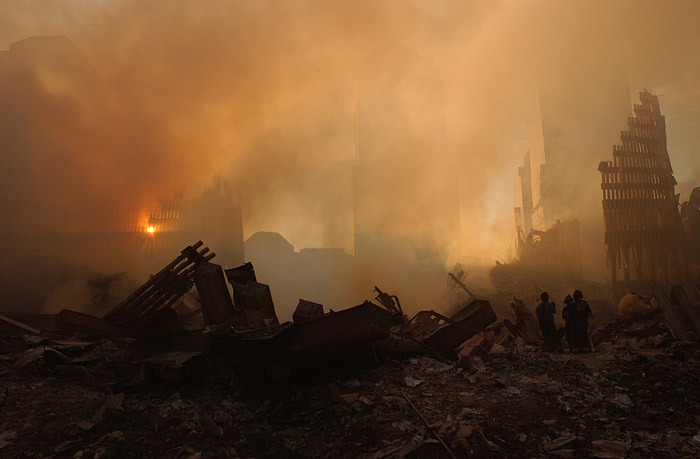
When the World Trade Center towers collapsed on September 11, 2001, survival appeared impossible for anyone still inside or immediately beneath them.
The South Tower fell at 9:59 a.m. The North Tower followed at 10:28 a.m. Within seconds, two 110-story skyscrapers were reduced to a massive, unstable field of twisted steel, shattered concrete and burning debris.
Yet amid that destruction, 20 people survived the collapses and escaped or were rescued from the wreckage, according to the widely cited accounting by USA Today that is also referenced in the supporting records of the 9/11 Commission.
Their stories remain among the most remarkable—and least widely understood—accounts from that day.
What the Number 20 Actually Means
The total includes people who were inside the towers, in the underground concourse or close enough to be buried when the buildings came down.
It does not mean that 20 people fell the entire height of the towers. Some survived because reinforced sections remained standing. Others were protected by pockets created beneath concrete slabs or steel beams.
Nevertheless, these people were still present when one or both towers collapsed around or above them.
The Miracle of Stairwell B
The largest group survived together inside the North Tower.
As firefighters descended Stairwell B, they encountered Port Authority employee Josephine Harris, who was exhausted and struggling with an injured leg. Rather than leave her, members of FDNY Ladder Company 6 slowed down and helped her descend.
That decision may have saved all of them.
When the North Tower began collapsing, the group was still inside the lower portion of Stairwell B. Much of the tower fell outward and around a section of the reinforced central stairwell, leaving a survivable pocket.
Fourteen people—12 firefighters, Port Authority Police Lt. David Lim and Harris—emerged alive from the remains of the tower.
The event became known as the “Miracle of Stairwell B.”
Fire Capt. John “Jay” Jonas later described the building as peeling away around them. The surviving section of stairwell protected the group from the enormous weight and force of the collapsing structure.
Had the firefighters abandoned Harris and continued downward at their original pace, they might have been in the lobby when the tower fell—an area that was almost completely destroyed.
Pasquale Buzzelli’s Impossible Fall
Pasquale Buzzelli, a Port Authority structural engineer, began the morning on the 64th floor of the North Tower.
He and several coworkers eventually began descending Stairwell B. When the tower started collapsing, Buzzelli was near the 22nd floor.
Hearing the building coming apart above him, he curled into a fetal position and held onto the stairwell railing. Then the stairs disappeared beneath him.
Buzzelli later recalled falling as the building collapsed around him. When he regained consciousness, he was lying on top of a pile of debris approximately 40 feet above ground level.
He suffered a broken foot and other injuries—but he was alive.
Buzzelli had apparently been carried downward inside a section of the collapsing stairwell before being deposited near the top of the wreckage. His survival has sometimes been described as “surfing” the collapse, although there is no complete explanation for how he lived.
Genelle Guzman-McMillan: 27 Hours Beneath the Rubble
Another Port Authority employee, Genelle Guzman-McMillan, also started that morning on the North Tower’s 64th floor.
She was descending with coworkers and had reached approximately the 13th floor when the tower collapsed.
Guzman-McMillan was thrown into the wreckage and pinned beneath concrete and steel. Her right leg was crushed, and she could not free herself.
She remained there through the afternoon, the night and into the following day.
For approximately 27 hours, she prayed, called for help and fought to remain conscious. A rescuer eventually heard her and reached through an opening to hold her hand.
Guzman-McMillan was freed on September 12 and became the final person pulled alive from the World Trade Center rubble.
Most of the coworkers who had descended with her did not survive.
The Officers Trapped Beneath the Towers
Port Authority Police officers Will Jimeno and John McLoughlin were in the underground concourse when the South Tower collapsed.
They and fellow officer Dominick Pezzulo took shelter near a freight elevator as the building came down. The surrounding structure created a small pocket, but the men were trapped beneath an estimated 30 feet of wreckage.
Pezzulo survived the initial collapse and attempted to free the others. He was later killed when the North Tower collapsed and shifted the debris above them.
Jimeno and McLoughlin remained pinned in darkness, seriously injured and unable to escape. Former Marines Jason Thomas and Dave Karnes eventually heard their calls and helped direct rescuers to them.
Jimeno was extracted after approximately 13 hours. McLoughlin, buried deeper in the wreckage, was rescued after roughly 22 hours.
Their survival story was later portrayed in Oliver Stone’s 2006 film World Trade Center.
Others Survived Beneath the Debris
There were additional extraordinary escapes around the base and underground areas of the complex.
South Tower employee Tom Canavan and another man were reportedly protected when a fallen concrete wall created a pocket around them in the underground concourse. They dug and crawled through the debris until they reached the surface.
Photojournalist David Handschuh was photographing the disaster when the South Tower collapsed. He was buried in the debris and suffered serious injuries, including a badly damaged leg, but firefighters found and carried him to safety.
The classification of individual survivors varies because some were inside a tower, some were beneath the complex and others were caught by the outward-moving debris. The historical accounting cited by the 9/11 Commission places the total who survived the collapse wreckage at 20.
Those Who Escaped Before the Collapse
The collapse survivors should not be confused with the thousands of people who evacuated before the towers fell.
Nobody located at or above the aircraft’s impact zone in the North Tower survived. The collision destroyed or blocked every escape stairway from the upper floors.
In the South Tower, however, Stairwell A remained passable after the impact. A small number of people from the impact area and floors above it located that stairway and reached the ground before the building collapsed.
Among them were Stanley Praimnath and Brian Clark. Clark heard Praimnath calling for help, pulled him from the wreckage of his office and accompanied him down more than 70 floors.
They survived the attack—but because they exited before the South Tower fell, they are not included among the 20 collapse survivors.
Survival in the Middle of the Impossible
The people who lived through the collapses survived through an extraordinary combination of structural protection, split-second decisions, rescue efforts and chance.
A group of firefighters refused to abandon an injured woman.
A man curled into a protective position as the floor disappeared beneath him.
A trapped woman continued calling for help for 27 hours.
Two gravely injured police officers kept one another conscious beneath 30 feet of wreckage.
Their survival does not diminish the 2,977 innocent lives taken in the September 11 attacks. Instead, their stories reveal another part of that day: moments of courage, endurance and humanity inside devastation that seemed unsurvivable.
Twenty people emerged from the collapse wreckage alive.
Twenty-five years later, the fact that anyone survived remains almost impossible to comprehend.
Sources
- National Commission on Terrorist Attacks Upon the United States: 9/11 Commission Report, Chapter 9: Heroism and Horror — Primary federal commission account of the attacks, evacuations and emergency response.
- National Commission on Terrorist Attacks Upon the United States: 9/11 Commission Report Notes — Supporting records citing the contemporary reporting on the 20 collapse survivors and Stairwell B.
- National September 11 Memorial & Museum: Survivor Recalls the Collapse of the Towers — Supports Will Jimeno’s account and the rescue of the trapped Port Authority officers.
- Fox News: How Stairwell B Became the Site of a Miracle Amid the Tragedy of Sept. 11 — Supports the identities and circumstances of the 14-person Stairwell B group.
- TIME: The Survivor: A Miracle’s Cost — Supports details concerning Genelle Guzman-McMillan and Pasquale Buzzelli.
- NBC New York: Rescued From Twin Towers, Survivor’s Guilt 10 Years Later — Supports Buzzelli’s location, fall and survival.
- FEMA via Wikimedia Commons: Ground Zero on 9-13-01 — Public-domain hero photograph and image-rights record.