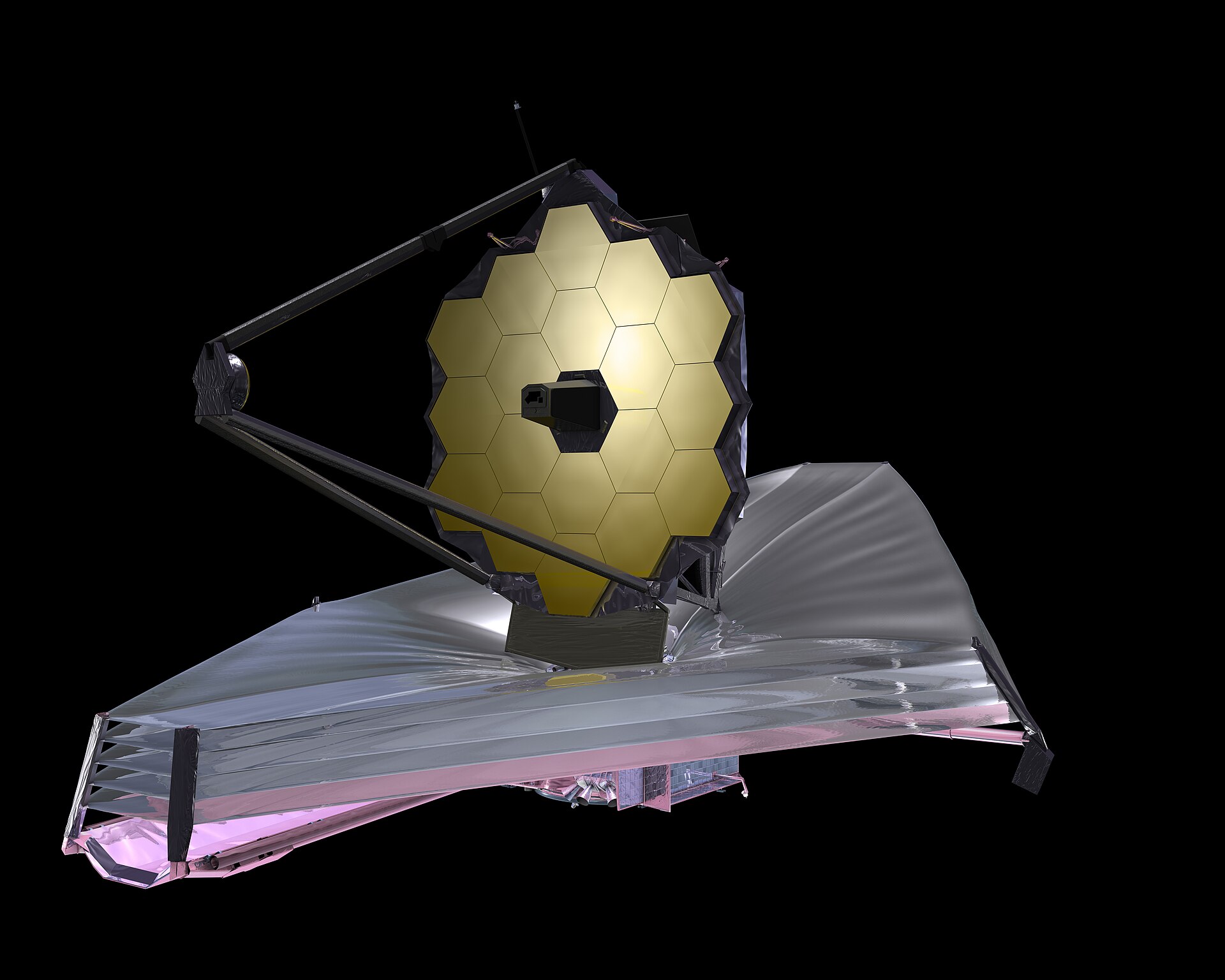
What reporters are saying
Over the past 48 hours several widely read outlets have run stories describing a James Webb Space Telescope (JWST) observation of an unusual compact source that some coverage labels a 'black hole star.' Forbes led with that label, while Mashable framed the report around an apparent behavior that some writers called theoretically surprising. New Scientist summarized a suggested explanation invoking 'not‑quite‑primordial' black holes as one possible route to the object's properties.
Those accounts agree on the basic pattern: Webb has detected an object whose measured properties sit at or beyond the conventional boundary between ordinary stars and compact black holes, prompting scientists to offer multiple, tentative interpretations. But the reporting assembled so far appears to be secondary: none of the stories in the set we reviewed link to a public NASA or Space Telescope Science Institute (STScI) press release, an arXiv preprint, or a peer‑reviewed paper from the Webb team that would allow independent verification of the data and analysis.
What 'black hole star' might mean (and what it probably does not)
The phrase 'black hole star' is not a standard class in astronomical taxonomy. Based on the reporting, it is being used as shorthand for an object that exhibits characteristics of both a compact accreting object and stellar‑like emission in ways that challenge simple classification. One line of interpretation reported in New Scientist invokes a form of compact black hole that is not strictly primordial in the cosmological sense but has properties that differ from well‑known stellar‑remnant black holes.
Other plausible, more conservative explanations that appear in the coverage include an extreme X‑ray binary or an unusual stage of stellar evolution where a dense remnant is interacting with a companion. Astrophysicists commonly resolve puzzling objects by comparing multiwavelength datasets—infrared from Webb, X‑ray from observatories such as Chandra or XMM, and radio observations—because accreting black holes and hot stars leave very different fingerprints across the electromagnetic spectrum. The stories we reviewed suggest scientists are debating whether Webb's infrared data reveal a genuinely new phenomenon or a surprising example of a known class seen in a new band or at an extreme parameter.
Why the claim is still provisional
Important elements of the discovery are currently missing from the public record. At the time of this report, we did not find a Webb team press briefing, a NASA or STScI press release, an arXiv preprint, or a peer‑reviewed article containing the full observations, spectra, light curves, and analysis that would let independent researchers check the claim. That absence matters because preliminary conference announcements and early interpretations can evolve after detailed scrutiny and additional data.
Robust confirmation in cases like this typically requires: (1) independent multiwavelength observations that reproduce the unusual features; (2) spectroscopic data that constrain temperature, composition, and motion; and (3) a transparent description of the data analysis and alternative models. The accounts in Forbes, Mashable, New Scientist and other outlets document scientists proposing competing explanations, but they also report the same caution: the label 'black hole star' is an interpretive shorthand, not an established new category of object supported by a published, peer‑reviewed analysis.
What to watch next
The clearest next signals to look for are a Webb team release or a preprint on arXiv that describes the observations and methods, followed by submissions to a refereed journal. Independently scheduled follow‑up by X‑ray and radio observatories would also strengthen the case by either corroborating or contradicting accretion signatures expected from black holes. If the object is truly at the intersection of known classes, teams elsewhere in the world will attempt to reproduce the key measurements and may propose observational tests that settle between competing models.
Until such primary documentation appears, readers should treat the label 'black hole star' as a working descriptor used in media reports rather than a confirmed new class of astronomical object. Responsible scientific practice requires both data transparency and independent confirmation, and both appear to be pending in this case.
Why this matters
Webb's sensitivity in the infrared opens windows on objects that were hard or impossible to study before, and that capability is precisely why preliminary claims like this attract attention. If the object proves to be a genuinely new phenomenon it could force refinements in our understanding of how compact objects form and interact with companions or the interstellar environment. Alternatively, if the object is an extreme example of a known class, it will still teach astronomers about the boundaries of those models.
Either outcome would demonstrate a routine but important pattern in modern astronomy: surprising observations drive new theoretical work, but scientific consensus forms slowly as independent teams test, replicate, and critique the initial interpretation.
Sources reviewed
- Forbes: Webb Telescope Finds A New Kind Of Object — A ‘Black Hole Star’
- mashable.com: This black hole just did something theoretically impossible
- New Scientist: ‘Not-quite-primordial’ black holes may explain baffling JWST discovery
- Universe Today: Physicists Determine Cause of "Runaway" Supermassive Black Hole
- UA.NEWS: Astronomers have discovered a strange object the boundary between a star and a black hole
- The Daily Galaxy: A Black Hole Was Seen Escaping Its Galaxy, Now Scientists Finally Found The Violent Event Behind It